



Adobe and JetForm technologies have played an important role in enterprise document generation for many businesses. Across manufacturing, insurance, government, healthcare, and other industries, organizations have built thousands of forms, templates, labels, and customer communications using JetForm, Adobe Central, Adobe LiveCycle, and Adobe Experience Manager Forms.
These systems often support essential business processes. They generate invoices, statements, policies, checks, shipping documents, compliance notices, and other high-volume communications. The templates and business rules behind those documents may represent years—or even decades—of development and refinement.
That investment remains valuable. However, the requirements surrounding enterprise document generation have changed.
Organizations now expect document systems to support real-time and high-volume batch processing, integrate with multiple business applications, deliver communications across several channels, accommodate cloud and API-driven architectures, and provide centralized control over templates and business rules.
For many businesses, modernization is no longer simply about replacing an older product. It is about ensuring that document operations can continue evolving alongside the enterprise.
Many Adobe and JetForm environments were initially implemented when document workflows were more centralized and predictable. Data typically came from a primary business system, documents were produced in batches, and print was often the principal delivery channel.
Today’s document environment is considerably more complex.
A company may need to generate thousands of invoices or statements in a scheduled batch while also producing individual documents in real time for a customer portal, mobile application, or service representative. The data behind those documents may come from an ERP, CRM, web application, legacy platform, or several systems working together.
Delivery requirements have expanded as well. Depending on the customer, process, or document type, output may need to be printed, emailed, archived, presented as HTML, or routed to another business workflow. Accessibility, localization, branding, security, and regulatory requirements must be applied consistently across every channel.
These changes place new demands on the document generation platform:
Real-time and high-volume batch processing
Integration with multiple data sources and business systems
Support for multiple OS deployments including Windows, Linux, IBMi and AIX
REST and SOAP API connectivity
Print and digital delivery from a common template
Centralized management of templates, branding, and business rules
Support for PDF/UA accessibility and international communications
Deployment flexibility across on-premises, cloud, and hybrid environments
The issue is not whether an established document system has delivered value. It is whether the architecture surrounding it can continue supporting the organization’s changing operational requirements.
Document requirements can vary by industry. The documents an organization produces, the systems supplying the data, the business rules involved, and the regulatory and delivery requirements can all shape what is needed from a modern document generation platform.
For example, in a manufacturing environment, document processes may produce invoices, packing slips, bills of lading, compliance labels, work orders, and product documentation. Each output must reflect accurate transaction and production data while meeting customer, carrier, and regulatory requirements.
For an insurance organization, document infrastructure may support policies, renewal notices, claims communications, correspondence, checks, and regulatory disclosures. These documents may require personalization, jurisdiction-specific language, accessibility, and reliable delivery through the recipient’s preferred channel.
Other industries bring their own combinations of document types, data sources, business rules, and compliance requirements. Although the specific outputs differ, organizations share the need to generate accurate, consistent communications across systems and delivery channels.
DocOrigin provides a flexible enterprise document generation platform for these varied requirements. It brings data, templates, business rules, formatting, and delivery processes together in a centralized document layer that can support different industries, applications, and document workflows.
As enterprise environments become more interconnected, embedding document logic within one application can create unnecessary limitations. Organizations may end up maintaining different templates, branding rules, and delivery processes across their ERP, CRM, web applications, and other systems.
A centralized document generation layer provides another approach.
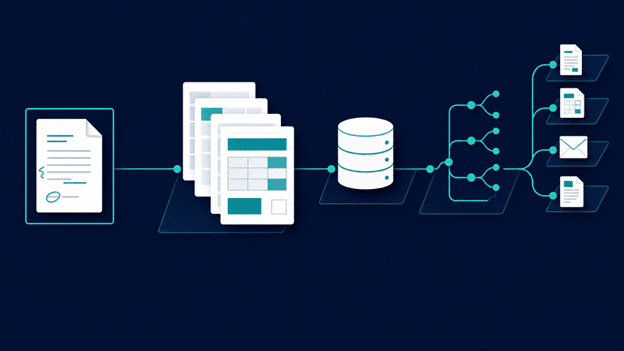
Business applications continue to manage transactions and supply data, while the document platform manages composition, formatting, business rules, and delivery. Multiple systems can use the same document service without recreating document logic inside each application.
This separation helps organizations introduce new applications, upgrade an ERP to the latest version, adopt cloud services, or modernize infrastructure without rebuilding their entire document environment each time. It also improves governance by allowing templates, approved content, branding, and output rules to be managed consistently.
DocOrigin supports this architecture by accepting established and modern data formats, including XML, JSON, CSV, and other structured or legacy inputs. REST and SOAP APIs allow applications and portals to request documents as part of real-time workflows, while the same platform supports high-volume batch production. DocOrigin supports deployment across Windows, Linux, AIX, and IBM i operating systems, giving organizations flexibility to align document generation with their existing infrastructure.
The result is a document infrastructure that can serve multiple applications rather than remaining dependent on one system or technology stack.
One of the largest barriers to replacing a legacy document platform is the perceived need to rebuild every form and template manually.
For organizations with hundreds or thousands of documents, those templates contain far more than visual layouts. They may include field definitions, formatting, conditional logic, tables, images, barcodes, reusable fragments, and other elements that have been tested and refined over many years.
A practical modernization strategy should preserve as much of that work as possible.
Eclipse provides an automated form-conversion service for existing JetForm IFD and Adobe LiveCycle XDP templates. The conversion process transfers supported template elements into DocOrigin, reducing the amount of manual recreation required and providing a much stronger starting point for validation and refinement.
Converted Adobe LiveCycle templates can retain important structural and design elements such as pages, subforms, fields, captions, barcodes, tables, images, fragment links, text objects, and formatting. Object scripting is also retained, and the previous requirement for a preamble or separate JMD file is no longer present in a modern document platform like DocOrigin, which prevents rebuilding years of document assets from scratch.
Business-critical document systems cannot always be replaced all at once. Different document families may have different owners, dependencies, data sources, testing requirements, and business deadlines.
DocOrigin can operate alongside existing JetForm and Adobe environments during migration. Organizations can convert and validate documents in phases, compare output, train users, and transition individual workflows according to business priorities.
This parallel approach provides several advantages:
High-priority or high-risk documents can be addressed first.
Converted output can be compared with current production output.
Business users can validate formatting, logic, and delivery requirements.
Teams can learn the new environment before assuming full responsibility.
Existing production processes can remain available while migration proceeds.
Instead of a disruptive “flip-the-switch” project, modernization becomes a controlled program with measurable stages and clear validation points.
Migrating enterprise forms requires more than knowledge of the destination platform. It also requires an understanding of how JetForm, Adobe Central, LiveCycle, and related technologies represent templates, data, and document logic.
Eclipse has been helping organizations work with and migrate from Adobe and JetForm technologies for more than 30 years. That experience informs both DocOrigin and Eclipse’s approach to conversion, implementation, testing, and parallel operation.
DocOrigin is an enterprise document generation platform for organizations that need to compose, generate, and deliver business-critical forms, documents, labels, and communications at scale.
For organizations evaluating the future of an established Adobe or JetForm environment, the objective should not be to discard the work that came before. It should be to preserve that investment while creating a document architecture prepared for new systems, new delivery channels, and new business requirements.
Learn more about replacing Adobe and JetForm document systems with DocOrigin or book a demonstration to discuss a phased modernization strategy.